Call for Papers, Intellectual Resonance, Vol. 9, December 2026
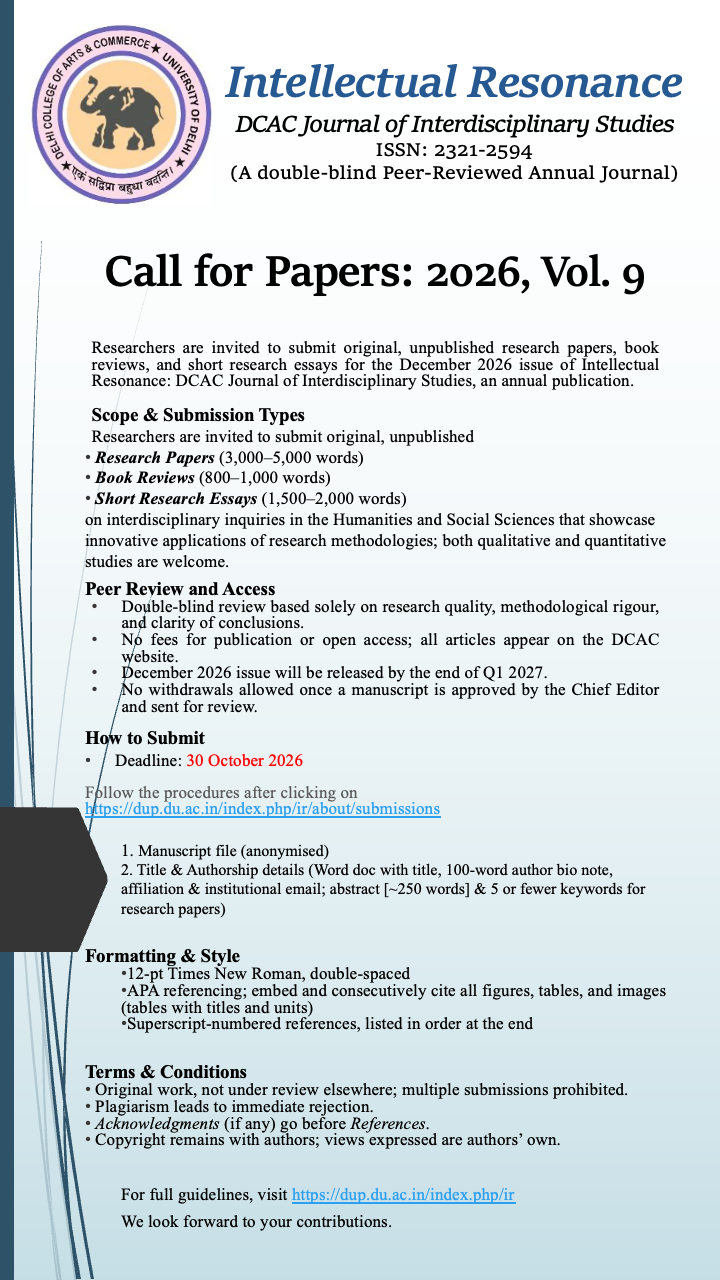
Researchers are invited to submit original, unpublished research papers, book reviews, and short research essays for the December 2026 issue of Intellectual Resonance: DCAC Journal of Interdisciplinary Studies, an annual publication.
Scope & Submission Types
Researchers are invited to submit original, unpublished
• Research Papers (3,000–5,000 words) • Book Reviews (800–1,000 words) • Short Research Essays (1,500–2,000 words)on interdisciplinary inquiries in the Humanities and Social Sciences that showcase innovative applications of research methodologies; both qualitative and quantitative studies are welcome.
Peer Review and Access
•Double-blind review based solely on research quality, methodological rigour, and clarity of conclusions. •No fees for publication or open access; all articles appear on the DCAC website. •December 2026 issue will be released by the end of Q1 2027. •No withdrawals allowed once a manuscript is approved by the Chief Editor and sent for review.How to Submit
•Deadline: 30 October 2026Follow the procedures after clicking on https://dup.du.ac.in/index.php/ir/about/submissions
1. Manuscript file (anonymised)
2. Title & Authorship details (Word doc with title, 100-word author bio note, affiliation & institutional email; abstract [~250 words] & 5 or fewer keywords for research papers)
Formatting & Style
•12-pt Times New Roman, double-spaced •APA referencing; embed and consecutively cite all figures, tables, and images (tables with titles and units) •Superscript-numbered references, listed in order at the endTerms & Conditions
• Original work, not under review elsewhere; multiple submissions prohibited. • Plagiarism leads to immediate rejection. • Acknowledgements (if any) go before References. • Copyright remains with authors; views expressed are authors’ own.
Reference Samples*
Grady, J. S., Her, M., Moreno, G., Perez, C., & Yelinek, J. (2019). Emotions in storybooks: A comparison of storybooks that represent ethnic and racial groups in the United States. Psychology of Popular Media Culture, 8(3), 207–217.
https://doi.org/10.1037/ppm0000185
Parenthetical citation: (Grady et al., 2019)
Narrative citation: Grady et al. (2019)
Whole authored book
Jackson, L. M. (2019). The psychology of prejudice: From attitudes to social action (2nd ed.). American Psychological Association. https://doi.org/10.1037/0000168-000
Parenthetical citation: (Jackson, 2019)
Narrative citation: Jackson (2019)
Whole edited book
Hygum, E., & Pedersen, P. M. (Eds.). (2010). Early childhood education: Values and practices in Denmark. Hans Reitzels Forlag. https://earlychildhoodeducation.digi.hansreitzel.dk/
Parenthetical citation: (Hygum & Pedersen, 2010)
Narrative citation: Hygum and Pedersen (2010)
Aron, L., Botella, M., & Lubart, T. (2019). Culinary arts: Talent and their development. In R. F. Subotnik, P. Olszewski-Kubilius, & F. C. Worrell (Eds.), The psychology of high performance: Developing human potential into domain-specific talent (pp. 345–359). American Psychological Association. https://doi.org/10.1037/0000120-016
Parenthetical citation: (Aron et al., 2019)
Narrative citation: Aron et al. (2019)
Webpage on a news website
Bologna, C. (2019, October 31). Why some people with anxiety love watching horror movies. HuffPost.
https://www.huffpost.com/entry/anxiety-love-watching-horror-movies_l_5d277587e4b02a5a5d57b59e
Parenthetical citation: (Bologna, 2019; Roberts, 2020; Toner, 2020)
Narrative citation: Bologna (2019), Roberts (2020), and Toner (2020)
Webpage on a website with an organizational group author
World Health Organization. (2018, May 24). The top 10 causes of death.
https://www.who.int/news-room/fact-sheets/detail/the-top-10-causes-of-death
Parenthetical citation: (World Health Organization, 2018)
Narrative citation: World Health Organization (2018)
*All sample references given above have been sourced from https://apastyle.apa.org/style-grammar-guidelines/references/examples. Scholars and researchers are advised to refer to the APA website for a more detailed guideline.